Cream and Brown Pineapple Lace Runner
Advanced
For experienced crocheters who enjoy complex shaping, fine detail, and ambitious construction
Weekend Project
A satisfying weekend make — start Friday, finish Sunday, enjoy forever.
Handmade Gift
A beautiful keepsake — free forever. Read online or print at home.
About This Cream and Brown Pineapple Lace Runner
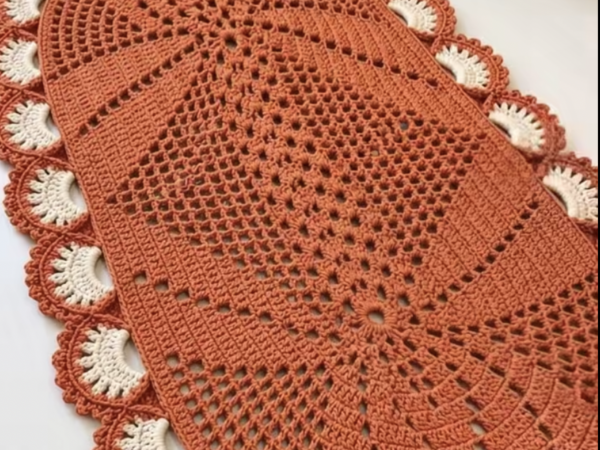
This Cream and Brown Pineapple Lace Runner is pure old-world elegance with a modern colour twist. Intricate cream lace medallions – diamond flowers, radiating spoke fans and classic pineapple scallops – are raised over a solid chocolate-brown ground, so the whole pattern stands up off the fabric and catches the light. Two colours, endless depth.
Why you will love making this piece
Pineapple lace is one of crochet’s great traditions, and working it in raised relief over a contrasting ground takes it somewhere special. The advanced part is managing two layers at once – a solid ground and a lace overlay that must line up – but the payoff is a runner with real sculptural depth. Every repeat you finish makes the rhythm clearer, and by the second medallion your hands simply know where the next shell goes.
Choosing your colours and yarn
A smooth DK cotton gives pineapple lace its crisp, architectural edges and keeps the raised layer from going limp. High contrast is your friend here: the darker and more solid the ground, the more the cream lace appears to float above it. Chocolate brown and cream is warm and unexpected; it reads as both rustic and refined depending on the room.
Understanding pineapple lace
A pineapple motif is simply a fan of stitches that grows, then is split by chain spaces that narrow round by round until it points – like the fruit it is named for. Once you see that logic, you stop counting blindly and start reading the shape. Mark the base of each pineapple and check that your chain spaces are decreasing evenly; that is the whole secret.
Layering lace over the ground
Work the solid brown ground first as a firm base, then build the cream lace medallions and attach them so their points and fans sit proud. Keep the ground tension slightly firmer than the lace so the overlay lifts rather than sags. This two-layer discipline is what separates a flat doily from a dimensional showpiece.
Blocking for architecture
Block the runner hard: pin every pineapple point and every scallop out crisply so the lace holds its shape. The brown ground should lie dead flat while the cream lace stands slightly proud. That contrast of flat and raised is the entire effect, and blocking is what locks it in.
A few ways to make it your own
Cream over deep green, white over navy, or ivory over burgundy all look sumptuous with this same stitch map. Work it all in one colour for a subtle tone-on-tone heirloom, or reverse it – brown lace over a cream ground – for a lighter look. Shorten the repeat count for a square centre doily.
Starting rounds — magic ring and first increases
Why You'll Love This Pattern 💛
Pineapple lace is one of crochet's great traditions, and working it in raised relief over a contrasting ground takes it somewhere special. The advanced part is managing two layers at once - a solid ground and a lace overlay that must line up - but the payoff is a runner with real sculptural depth. Every repeat you finish makes the rhythm clearer, and by the second medallion your hands simply know where the next shell goes.
Shaping with increases — building the body
Switch Things Up 🎨
Cream over deep green, white over navy, or ivory over burgundy all look sumptuous with this same stitch map. Work it all in one colour for a subtle tone-on-tone heirloom, or reverse it - brown lace over a cream ground - for a lighter look. Shorten the repeat count for a square centre doily.
Colour variations — personalise your make
Common Mistakes & How to Fix Them 🔧
Your chain spaces are not decreasing evenly - recount each row and make sure you skip the same number of spaces each time.
The ground is too loose or the overlay too tight; firm up the ground tension and block the finished piece hard.
Mark the base of each pineapple and measure between them; small drift compounds over a long runner.
Add a row or two of firm sc all around the ground before attaching the lace, and block it flat.
Assembly stage — pinning pieces before sewing
Materials Needed for Cream and Brown Pineapple Lace Runner
🧶YARN
🪝TOOLS & NOTIONS
— Gauge:
one pineapple repeat = ~10 cm
— Finished Size:
~105 x 36 cm (41 x 14 in)
— Yarn Weight:
DK Cotton
— Hook:
3.0mm
— Terms:
US Crochet Terminology
— Cost:
FREE ✓
Crochet Abbreviations
Cream and Brown Pineapple Lace Runner — Full Pattern
🧶SOLID BROWN GROUND (brown)
🧶PINEAPPLE MEDALLION (cream, repeat along centre)
🧶DIAMOND FLOWER (cream)
🧶EDGE (cream)
Assembly & Finishing Tips
💡 Weaving in ends
Use a tapestry needle to weave each tail back and forth through at least 5–6 stitches in different directions. A tiny dot of washable glue on the final stitch before trimming adds extra security for toys used by children.
💡 Sewing pieces together
Pin each piece firmly to the body before sewing. Use mattress stitch for the most invisible join — insert the needle under the same yarn bar on alternating pieces and pull firmly. Knot securely at start and end, weave both tails deep into the body.
💡 Positioning safety eyes
Take time here — eye spacing determines the character's entire personality. Closer eyes look more intense; further apart looks more friendly and playful. Pin both positions and step back before snapping the backs on permanently. Once snapped, eyes cannot be moved without damaging the fabric.
💡 Blocking
Not required for amigurumi, but lightly steam-blocking any warped pieces will relax the fibres. Hold a steam iron a few centimetres away — never let it touch the stuffing or safety eyes directly.
💡 Care instructions
Handwash in cool water with mild detergent, press gently to remove excess water, lay flat to dry. Many acrylic yarns are machine washable on a gentle cycle in a laundry bag — always check your yarn label.
⚠️ Important Notes
- Use stitch markers at the start of every round — don't rely on memory to count.
- Work with consistent tension throughout. Gauge swatch before starting if in doubt.
- Fasten off leaving long tails for sewing — at least 30cm for each piece you'll need to attach.
- Pin and check positioning of all pieces before sewing any of them permanently.
Beginner's Guide to Amigurumi 🌱
Amigurumi (Japanese: ami = knitted/crocheted + nuigurumi = stuffed toy) is the craft of making small crocheted characters. You start with a magic ring, work in continuous spiral rounds of single crochet, and shape the piece through increases and decreases — no seams, no joins, no turning.
The magic ring creates a closable centre with no hole. Wrap yarn around two fingers, insert the hook, yarn over and pull through. Work your first round into this ring, then pull the tail to close tight. Practise a few times — it becomes effortless quickly.
The invisible decrease — insert your hook through the front loop only of the first stitch, then the front loop only of the second stitch. Yarn over, pull through both loops, then yarn over again and pull through the remaining two. Working through front loops only makes the decrease blend into the fabric instead of leaving a bump.
Tension matters most. Amigurumi needs tight, firm tension so stuffing can't show through. If you can see white fiberfill peeking between your stitches, go down one hook size. The fabric should feel dense and firm — like a tightly woven canvas, not a loose net.
The finished Cream and Brown Pineapple Lace Runner — ready to gift or display
You Ask, We Answer ❓
It is the shaping - keeping the fans growing and then decreasing evenly to a point while flanking them with spoke-fans. The stitches are standard; the counting and rhythm are the challenge.
No - a single-colour version is beautiful and a little easier. The two-layer contrast version is the showpiece, but tone-on-tone is a lovely, calmer option.
Work the ground a touch firmer than the overlay and block hard, pinning every point so the lace holds its raised shape.
Yes - you may sell finished handmade pieces. Please credit Cozy Amigurumi as the designer; you may not resell or redistribute the pattern itself.