Teal Filet Crochet Leaf Table Runner — Free Crochet Pattern
Advanced
For experienced crocheters who enjoy complex shaping, fine detail, and ambitious construction
Weekend Project
A satisfying weekend make — start Friday, finish Sunday, enjoy forever.
Handmade Gift
A beautiful keepsake — free forever. Read online or print at home.
About This Teal Filet Crochet Leaf Table Runner — Free Crochet Pattern
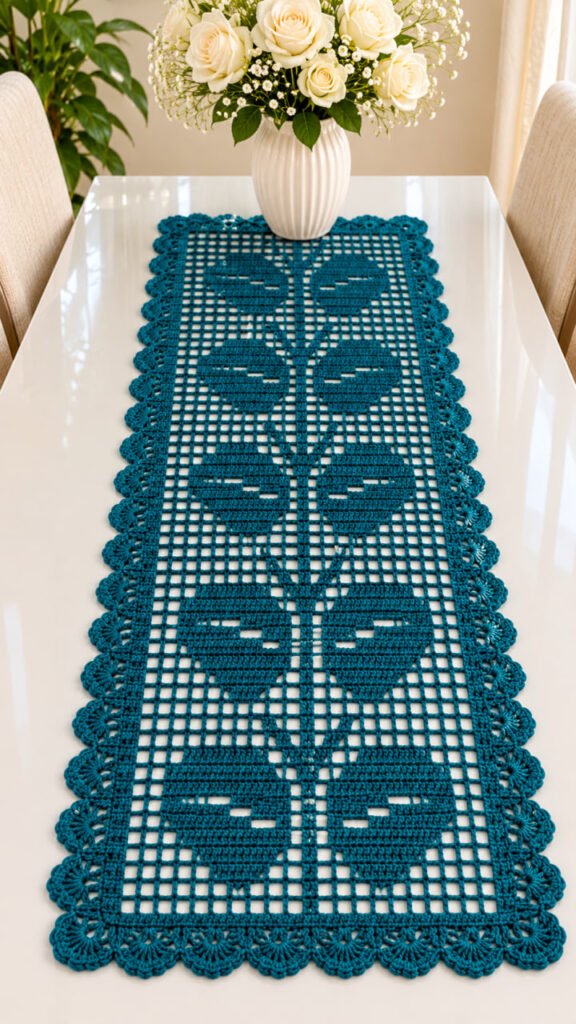
Filet crochet is the art of drawing with stitches: every square is either an open mesh “window” or a solid block, and together they form a picture. This teal runner draws a simple, modern botanical – a straight central stem with five pairs of large leaves branching off it – framed by a solid border and finished with a deep fan-shell edge. The rich teal colour makes it a striking contrast on a white or light wood table, but it is just as beautiful in classic white.
Why make a filet leaf runner?
- It is graphic and modern – clean shapes instead of fussy lace, so it suits contemporary dining rooms.
- It is rhythmic to make – only two units (mesh and block) are worked across every row.
- It teaches real chart reading – once you can follow the leaf rows below you can work any filet chart.
Skill level: advanced
The stitches are only chain and double crochet, but filet at this size demands accuracy. You must keep a perfect stitch count across 33 squares for 87 rows, keep your blocks and meshes the same width, and mirror the leaves correctly on each side of the stem. One misplaced block in a leaf is visible from across the room, so we recommend a row counter and a highlighter for the row list.
Understanding the grid
The runner is 33 squares wide:
- Square 1 and square 33 are always solid – the vertical side frame.
- Square 17 (the exact centre) is always solid – the stem.
- Squares 2–16 are the left half; squares 18–32 are the right half, worked as a mirror image of the left.
Each row in the pattern gives the left half only, e.g. “M1, B12, M2”. You work: frame block, the left-half sequence, the stem block, the same sequence in reverse (M2, B12, M1), frame block. Mark square 17 with a locking marker on every row and you can never lose your place.
Mesh and block maths
A mesh (M) is dc, ch 2, skip 2. A block (B) is 3 dc. Every square shares its first dc with the neighbour, so a row of 33 squares has 33 x 3 + 1 = 100 stitches. The foundation chain is 102 ch – the three chains you skip at the start count as the first dc. If your blocks look wider than your meshes, your chains are too tight – this is the most common filet problem, and the cure is to chain more loosely, not to change hook.
The leaves
Each leaf grows from a short diagonal branch that leaves the stem, swells to 12 squares wide and tapers back to a point. Two small open “vein” slits run through the widest rows – a lovely detail that makes the leaves read as leaves rather than blobs. One leaf pair takes 16 rows; the pair is repeated five times along the runner.
Thread and size options
- Sport / light DK mercerised cotton, 3.0 mm – 50 x 115 cm, about 420 g (as in the photo).
- Size 10 crochet thread, 1.75 mm – a delicate 32 x 75 cm heirloom runner, about 150 g.
- DK cotton, 3.5 mm – a bolder 56 x 130 cm runner, about 520 g.
To change the length, add or remove whole 16-row leaf pairs.
Blocking a filet runner
Filet only looks right when every square is square. Pin the runner out on a grid mat, pin both side frames in perfectly straight lines first, then pin every 5th row. Spray with water, then with light starch, and let it dry completely. The edging scallops get a pin in each shell centre.
Styling
Teal on white marble or white gloss is dramatic; teal on oak is warm and Scandinavian. Keep the centrepiece low and pale (white roses, eucalyptus) so the leaves stay the star. For a matching set, work a 33 x 33 square of one leaf pair rotated four times as placemats.
Love filet? See also our Lavender Diamond Lace Table Runner and the Sunflower Swirl Lace Table Runner, or browse all our free crochet table runner patterns.
Starting rounds — magic ring and first increases
Why You'll Love This Pattern 💛
A clean, modern botanical drawn square by square – one stem, ten big leaves and a fan edge that frames it like a picture.
Shaping with increases — building the body
Switch Things Up 🎨
White or ecru for an heirloom look, sage green on oak for a Scandi table, or rust orange for an autumn version.
Colour variations — personalise your make
Common Mistakes & How to Fix Them 🔧
You lost a stitch at the row ends. The turning ch 3 counts as a dc – always work the last dc into the top of the previous turning chain.
The right half was not mirrored. Read the left-half sequence backwards for the right half.
Your dc are taller than the 2-ch is wide. Chain a little looser or go down 0.25 mm.
Square 17 was miscounted. Keep a locking marker in the stem block and move it up every row.
Too many sc in Rnd 1. Use 2 sc per row-end along the sides and check the multiple of 6 + 1.
Filet needs blocking. Pin the side frames straight, mist and starch.
Assembly stage — pinning pieces before sewing
Materials Needed for Teal Filet Crochet Leaf Table Runner — Free Crochet Pattern
🪝Tools & Notions
(US C/2–D/3) crochet hook
(row start + centre square)
— Gauge:
8 mesh squares and 8 rows = 10 cm
— Finished Size:
approx. 50 x 115 cm including edging
— Yarn Weight:
Sport / light DK mercerised cotton (teal)
— Hook:
3.0 mm (US C/2–D/3)
— Terms:
US Crochet Terminology
— Cost:
FREE ✓
Crochet Abbreviations
Teal Filet Crochet Leaf Table Runner — Free Crochet Pattern — Full Pattern
🧶Notation
🧶Foundation
🧶Leaf pair (16 rows) – work 5 times (Rows 5–84)
🧶Top
🧶Edging
Assembly & Finishing Tips
💡 Weaving in ends
Use a tapestry needle to weave each tail back and forth through at least 5–6 stitches in different directions. A tiny dot of washable glue on the final stitch before trimming adds extra security for toys used by children.
💡 Sewing pieces together
Pin each piece firmly to the body before sewing. Use mattress stitch for the most invisible join — insert the needle under the same yarn bar on alternating pieces and pull firmly. Knot securely at start and end, weave both tails deep into the body.
💡 Positioning safety eyes
Take time here — eye spacing determines the character's entire personality. Closer eyes look more intense; further apart looks more friendly and playful. Pin both positions and step back before snapping the backs on permanently. Once snapped, eyes cannot be moved without damaging the fabric.
💡 Blocking
Not required for amigurumi, but lightly steam-blocking any warped pieces will relax the fibres. Hold a steam iron a few centimetres away — never let it touch the stuffing or safety eyes directly.
💡 Care instructions
Handwash in cool water with mild detergent, press gently to remove excess water, lay flat to dry. Many acrylic yarns are machine washable on a gentle cycle in a laundry bag — always check your yarn label.
⚠️ Important Notes
- Use stitch markers at the start of every round — don't rely on memory to count.
- Work with consistent tension throughout. Gauge swatch before starting if in doubt.
- Fasten off leaving long tails for sewing — at least 30cm for each piece you'll need to attach.
- Pin and check positioning of all pieces before sewing any of them permanently.
Beginner's Guide to Amigurumi 🌱
Amigurumi (Japanese: ami = knitted/crocheted + nuigurumi = stuffed toy) is the craft of making small crocheted characters. You start with a magic ring, work in continuous spiral rounds of single crochet, and shape the piece through increases and decreases — no seams, no joins, no turning.
The magic ring creates a closable centre with no hole. Wrap yarn around two fingers, insert the hook, yarn over and pull through. Work your first round into this ring, then pull the tail to close tight. Practise a few times — it becomes effortless quickly.
The invisible decrease — insert your hook through the front loop only of the first stitch, then the front loop only of the second stitch. Yarn over, pull through both loops, then yarn over again and pull through the remaining two. Working through front loops only makes the decrease blend into the fabric instead of leaving a bump.
Tension matters most. Amigurumi needs tight, firm tension so stuffing can't show through. If you can see white fiberfill peeking between your stitches, go down one hook size. The fabric should feel dense and firm — like a tightly woven canvas, not a loose net.
The finished Teal Filet Crochet Leaf Table Runner — Free Crochet Pattern — ready to gift or display
You Ask, We Answer ❓
Yes – draw a grid 33 squares wide. Fill square 1, 17 and 33 on every row, then shade the left-half blocks from the row list and mirror them on the right.
Your mesh and blocks are different widths. Chain more loosely in the meshes so 2 ch equal the width of 2 dc.
Add more 16-row leaf pairs. Each pair adds about 20 cm.
Yes – work the right half of each row from a leaf row that is 8 rows behind the left half.
Mercerised cotton. It blocks crisply and the leaves stay flat.
Light starch keeps the mesh square on the table; it is optional for wall hangings.
Finished handmade pieces may be sold – please credit Cozy Amigurumi. Do not resell or redistribute the pattern itself.